Ask five providers to quote the same logo, and you might get $200, $900, $4,000, a $799 monthly plan, and a job description. None of them is wrong. They are five ways of selling the same skill, each priced on its own logic.
Short answer: In 2026, graphic design services run roughly $25 to $150 an hour with a freelancer and $75 to $175 an hour at an agency. Flat-rate subscriptions sit between $400 and $1,400 a month. A full-time in-house designer averages about $67,000 a year. Pick the model that matches your volume.
Design buying at a glance
| What you want to know | The short version |
|---|---|
| Hourly rates in 2026 | $25 to $150 freelance, $75 to $175 at a studio |
| Logo, typical range | $300 to $2,500 freelance, $5,000 and up at an agency |
| Full brand identity | $1,000 to $5,000 freelance, $20,000 and up at an agency |
| In-house designer | About $67,000 a year, plus overhead |
| Editable source files | Often excluded unless the contract says so |
| Fonts | Licenses rarely transfer, so you buy your own |
TL;DR
- Rates in 2026 run from $25 to $175 an hour, and the gap is mostly process, not talent.
- Under about 10 hours of work a month, a freelancer wins on cost. Above 20 hours a week, hire someone.
- Get source files and copyright assignment in writing before the first invoice, not after the last one.
- AI has absorbed the fast, repetitive production work. It has not absorbed the judgment calls.
What you actually get for the money
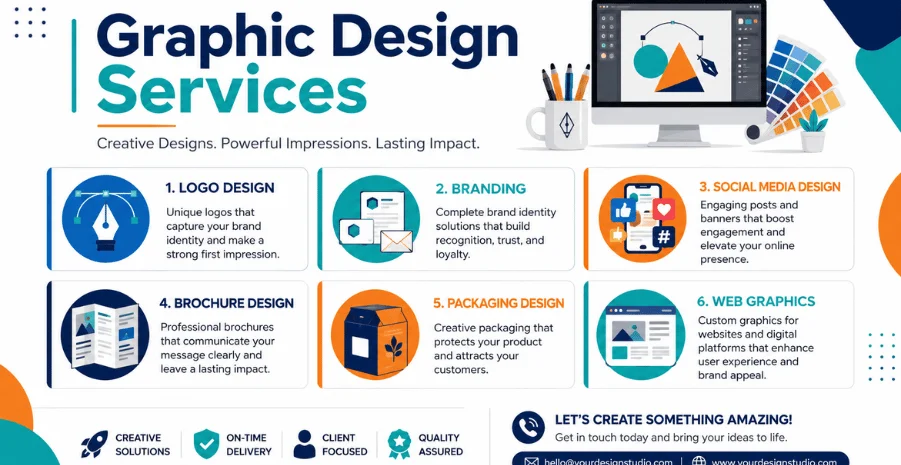
Most providers sort their work into a few buckets. Knowing which one your problem sits in makes quotes far easier to compare.
- Identity work: logo, color palette, typography, icon set, usage guide.
- Marketing collateral: ads, one-pagers, brochures, trade show panels, and sell sheets.
- Digital and social: banners, post templates, email headers, landing page visuals.
- Packaging and print: labels, boxes, dielines, and print-ready artwork.
- Presentation and motion: pitch decks, report layouts, short animated cuts.
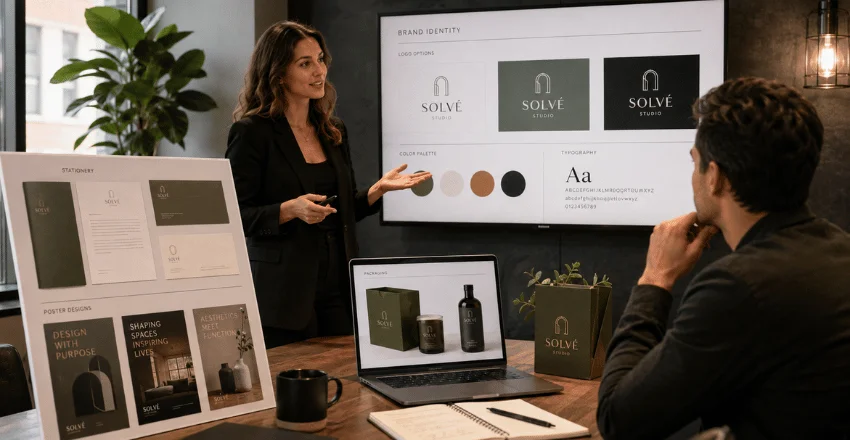
Identity work is the piece buyers underestimate. It is not decoration. Recognition and recall are what give a brand its power when every competitor sits one scroll away. That is what you are paying a designer to build.
What graphic design services cost in 2026
Here is how the five models compare on price, speed, and risk, using published 2026 US rates and salary data.
| Model | 2026 price | Typical turnaround | Best for | Watch out for |
|---|---|---|---|---|
| Marketplace gig | $55 to $500 per asset; Pro tiers: $310 to $5,000 | 1 to 5 days | One-off, low-stakes assets | Recycled templates, no strategy |
| Independent freelancer | $25 to $150 an hour, logo $300 to $2,500 | 1 to 3 weeks | Occasional, small-scale needs | One person, no backup |
| Studio or agency | $75 to $175 an hour, minimums near $1,500 to $3,000 | 4 to 12 weeks | Rebrands, packaging, regulated print | Slow, with a high floor |
| Unlimited subscription | $400 to $1,400 a month typically | 1 to 2 days per request | Steady weekly output | Queue limits, thin on strategy |
| In-house hire | About $67,000 a year, plus overhead | Same day | 20+ hours of design a week | Fixed cost in quiet months |
Retainers sit between the freelance and agency rows. You reserve a block of monthly hours and usually save 10 to 20 percent against the hourly rate, with typical retainers running $1,500 to $10,000 a month.
Pros and cons, model by model
Marketplace gig. Pros: fast, cheap, and no commitment. Cons: you often get a template with your name swapped in, and the trademark office does not care that you paid for it.
Independent freelancer. Pros: direct access to the person doing the work and strong value per dollar at a small scale. Cons: capacity ends where their week ends, and vacations stop your pipeline.
Studio or agency. Pros: research, art direction, project management, plus a team that covers illustration, print, and motion. Cons: the minimum spend rules out small jobs entirely.
Unlimited subscription. Pros: predictable cost and quick turnaround, with no scoping argument over every request. Cons: “unlimited” means unlimited requests in a queue, not unlimited simultaneous work.
In-house hire. Pros: they learn your product, your tone, and your approval chain—cons: salary, benefits, and software land, whether the workload does or not.
The verdict: which one should you pick

If you need one logo and a set of business cards, hire a freelancer in the $800 to $2,500 range and skip everything else. The agency version of that project costs five times more and does not sell five times more.
If your team ships weekly ads and social posts, a subscription in the $400 to $1,400 band beats hourly billing before you reach ten requests a month. Read up on what makes ad creative work before you brief anyone, because a fast designer working from a weak brief produces bad work faster.
If you are repositioning the company, changing your name, or moving into retail packaging, pay the agency. Discovery, naming checks, and print production are where their hourly rate earns out. Hire in-house once you are consistently buying more than 20 hours of design a week. Below that, you are paying a salary to keep someone waiting.
The source file trap most buyers miss
This is where cheap engagements turn expensive, and almost nobody asks about it until something goes wrong.
Copyright in design work stays with the designer by default. Paying an invoice is not the same as owning the result. Unless the contract assigns copyright to you or grants a license wide enough for your plans, the designer keeps the rights.
Source files follow the same pattern. Many contracts list the deliverables as final PDF, JPEG, and SVG exports, then state that working files remain the designer’s property. Some studios release them at handover for a release fee, often a percentage of the project total. Ask which applies before you sign, not eighteen months later.
Fonts are the trap inside the trap. When a designer buys a typeface, they buy a license to use it, not the file itself. Most commercial licenses forbid passing that file to you, so a clean handover means you buy your own license for the fonts in your identity. Budget $30 to $300 for that, and get the exact font names in your brand guide.
One more line worth adding to any agreement: a plain-English definition of a revision round. Vague revision language is the single most common reason a fixed-price project drifts.
Where AI has and has not replaced paid design
Both sides of this argument are oversold. Here is an evenhanded read of the split as of 2026, covering the tasks AI absorbed and the tasks it has not.
AI has taken real work off the table. Background removal, resizing one layout into fifteen ad sizes, first-pass stock imagery, and simple icon sets now take minutes of prompting rather than billable hours. If that was the bulk of what you outsourced, your bill should have dropped. Most working designers use these tools weekly, which is part of why subscription prices stay flat while output rises.
What has not moved is the part that requires a decision—picking a position in a crowded market. Killing a concept the founder loves. Reading a room during a stakeholder review and checking that a mark is legally clear. None of that is a prompt. The Bureau of Labor Statistics still projects slow but positive growth for design roles this decade. Demand for interface and motion work is climbing faster than for static print.
The practical takeaway is unglamorous. Use AI to cut production costs. Keep paying humans for the calls that are hard to reverse.
How to judge the work when it lands
Design is easier to assess than people think, as long as you agree on the test before you see the concepts.
- Does it survive at thumbnail size and in one color?
- Can you name the audience it is aimed at without being told?
- Does it look different from the three competitors you named in the brief?
- Do the files open, print, and export at the sizes you actually publish?
Then check the numbers. Run the new creative against the old set for a few weeks and compare engagement. Be careful, because how impressions and reach are counted differs by platform and will skew a casual before-and-after.
Questions to ask before you sign

- Which editable source files do I receive, and when?
- Is copyright assigned to me, or am I getting a license? What does the license cover?
- Which fonts will you use, and what will they cost me to license?
- How many revision rounds are included, and what counts as one?
- Who is my point of contact, and who does the actual design work?
- Can I see live work in a similar market, with the brief behind it?
If a provider gets vague on the first three, that is your answer. Cheap quotes hide the cost somewhere, usually in ownership or revisions.
Your next step
Write a one-page brief before you contact anyone. Name the business problem, the three competitors you want to look nothing like, the assets you need, and your budget range. Send it to one freelancer, one subscription provider, and one studio. The quotes will tell you which model fits better than any pricing guide can.
Frequently asked questions
Typically logo and identity work, marketing collateral, digital and social assets, packaging, and presentation layouts. Exports are standard. Editable working files, unlimited revisions, and print management are usually priced separately.
A realistic first-year figure is $2,000 to $6,000. That covers a logo and basic identity, a small collateral set, and a few months of ad and social assets.
Only if the contract says so, without a written assignment, copyright sits with the designer, and you hold whatever license the agreement grants.
It pays off with roughly eight to ten requests a month. Below that, hourly freelance work is cheaper. Check how many requests run at once, since that queue limit sets your real turnaround.
For a placeholder, yes. For a mark you will trademark and use for a decade, no. Generated logos tend to repeat common shapes, which is exactly what causes registration problems later.
Four to eight weeks with a freelancer and eight to twelve weeks at an agency. A standalone logo is faster, often one to three weeks.