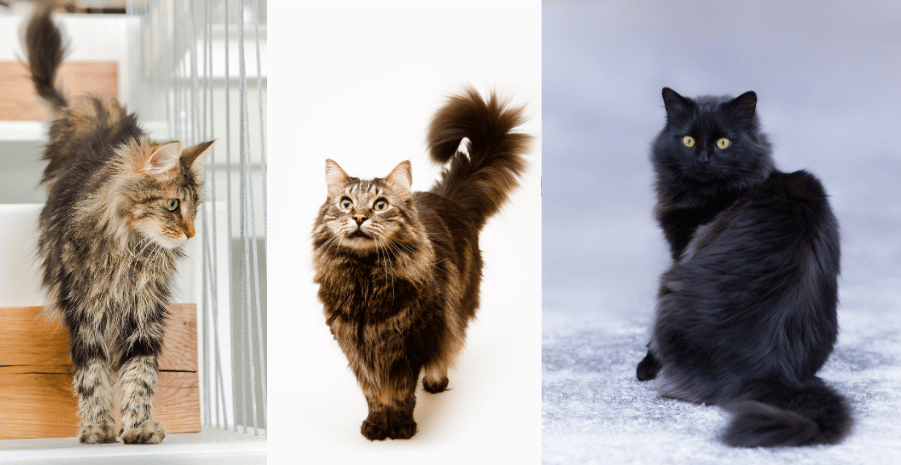
Determining whether cats are smarter Than Dogs isn’t straightforward, as each species excels in different types of intelligence. Dogs are naturally social, skilled at reading human cues, and quick to follow commands, while cats are independent thinkers, excelling at problem-solving, observation, and adaptability.
Rather than one being universally smarter, their intelligence reflects their unique evolutionary strengths. Dogs thrive in teamwork and social learning, while cats shine in self-reliance and strategic thinking. Are cats smarter than dogs? The answer isn’t simple, as each species excels in different types of intelligence, from social skills to problem-solving and adaptability.
| Aspect | Dogs | Cats | Examples/Notes |
| Social Intelligence | Highly cooperative, responds well to humans | Moderate – more solitary, less socially cooperative | Dogs excel in teamwork; cats prefer independence |
| Problem-Solving | Moderate – motivated by social rewards | High – motivated by curiosity and survival instincts | Cats can open doors, solve food puzzles independently |
| Trainability | High – follow commands, routines | Moderate – independent, harder to motivate with commands | Dogs excel in obedience training; cats learn selectively |
| Memory | Good for social cues and routines | Excellent for navigation, survival, and observation | Cats remember hunting routes; dogs remember commands |
| Emotional Understanding | High–sense human emotions | Moderate – respond mainly when directly affected | Dogs comfort humans; cats show subtle cues of attachment |
| Brain Structure | ~530 million cortical neurons | ~250 million cortical neurons | More neurons in dogs support complex social behavior; cats excel in independent tasks |
| Motivation | Social – please humans | Independent – curiosity and self-reward | Dogs follow reinforcement; cats act when personally motivated |
| Communication | Respond to gestures, tones, and facial expressions | Meowing for humans, purring, and subtle body language | Dogs are more socially tuned; cats communicate selectively |
Are Cats Smarter Than Dogs?

Are cats smarter than dogs? The answer isn’t simple, as each species excels in different types of intelligence, from social skills to problem-solving and adaptability. It is a complex and often debated topic, as intelligence can manifest in many ways. Dogs and cats have evolved differently, which affects the types of intelligence they display. Dogs, as social pack animals, excel in social intelligence, obedience, and cooperation, making them highly trainable and responsive to human commands and emotional cues.
Cats, on the other hand, evolved as solitary hunters and rely heavily on independent problem-solving, adaptability, and environmental awareness. While dogs may outperform cats in tasks that require social learning or teamwork, cats often excel in observational learning, strategic thinking, and self-directed problem-solving.
Scientific studies also reveal differences in brain structure: dogs have more cortical neurons associated with complex behaviors, while cats possess fewer neurons but demonstrate remarkable agility, memory, and spatial reasoning. Ultimately, whether cats are “smarter” than dogs depends on how intelligence is defined.
Understanding Animal Intelligence

Intelligence in animals is not as straightforward as it is in humans. Researchers typically evaluate intelligence based on:
- Problem-Solving Ability: How effectively an animal can find solutions to challenges.
- Memory: The capacity to recall information or learn from experience.
- Social Intelligence: Ability to understand social cues, communicate, and cooperate with others.
- Adaptive Behavior: How well an animal can survive and adjust in its environment.
Dogs and cats display these forms of intelligence differently due to their evolutionary backgrounds.
Why Do Cats and Dogs Differ?
Cats (Felis catus) and dogs (Canis lupus familiaris) have evolved along very different paths, which have shaped the way their intelligence manifests. Dogs, descended from wolves, evolved as pack animals, a history that favors social intelligence, cooperation, and obedience.
This background enables them to understand human commands, read emotions, and work effectively as a team, making them highly trainable and responsive to social cues. Cats, on the other hand, descended from solitary hunters and rely more on independent problem-solving and survival skills.
Their intelligence is primarily geared toward self-sufficiency, stealth, and environmental awareness rather than social cooperation or obedience. These evolutionary differences explain why dogs are often more trainable and socially oriented, while cats may seem aloof yet excel in individual tasks that require observation, strategy, and adaptability.
Scientific Studies on Cat and Dog Intelligence
Brain Size and Structure
One common measure of intelligence is brain size and neuron density:
- Dogs have about 530 million cortical neurons, the part of the brain associated with thinking, planning, and complex behavior.
- Cats have roughly 250 million cortical neurons, which is fewer than dogs but more than many other mammals.
This might suggest dogs have an advantage in complex behaviors, especially those requiring social cooperation. However, cats may excel in tasks requiring independent problem-solving.
Problem-Solving and Learning
Studies have shown that cats are excellent at observational learning. They can watch a human or another cat solve a problem and replicate it later. Dogs, meanwhile, are more responsive to reinforcement-based training, learning tricks and commands faster due to their social orientation.
- Cats can solve puzzles to obtain food, but they may only do so if motivated.
- Dogs will often work to please their owner and follow commands reliably.
Social Intelligence and Communication
Dogs outperform cats in understanding human gestures, voice tones, and facial expressions. They are highly attuned to human emotional states and can learn cooperative tasks easily.
Cats, on the other hand, communicate differently:
- Meowing is primarily used to interact with humans, not other cats.
- Purring, body language, and subtle cues are their main communication tools.
- They are more independent, which can be misinterpreted as lower intelligence.
Memory and Adaptability
Cats have excellent short-term and long-term memory, especially when it comes to survival skills, hunting strategies, or recognizing humans. Dogs also have good memories, but often excel in remembering cues associated with commands or routines.
- Cats may remember hiding spots or hunting routes for years.
- Dogs are more likely to remember social cues, routines, and commands that benefit pack living.
Behavioral Examples

Cats
- You can open doors or cupboards by learning how handles work.
- May figure out how to operate food puzzles independently.
- Often learn by observation, showing adaptability and curiosity.
Dogs
- Can follow complex commands, sometimes performing multiple-step tasks.
- Can be trained for service roles, such as guiding the blind or detecting medical conditions.
- Often show empathy and emotional intelligence, comforting humans in distress.
Can We Really Compare Cat and Dog Intelligence?
| Aspect | Dogs | Cats |
| Social intelligence | High; cooperate and respond to humans | Moderate; more solitary, less socially cooperative |
| Problem-solving | Moderate; motivated by social rewards | High, motivated by curiosity or survival instincts |
| Trainability | High; follow commands and routines | Moderate; independent, harder to motivate with commands |
| Memory | Good for social cues | Excellent for navigation, survival, and observation |
| Emotional understanding | High sense of human emotions | Moderate; respond mainly when directly affected |
Popular Misconceptions

A common misconception is that cats are lazy and unintelligent. Cats are highly independent and selective, often choosing when and how to demonstrate their intelligence rather than constantly seeking attention or approval. Another widespread belief is that dogs are always smarter than cats.
While dogs do excel in social contexts and are quick to follow commands, cats can outperform dogs in problem-solving tasks and in learning by observation, showing a different but equally valuable type of intelligence.
Additionally, many people equate trainability with intelligence, if the ability to follow commands defines a smart animal. However, intelligence is multifaceted, and a cat’s independent nature should not be mistaken for a lack of cognitive ability, as their skills often manifest in curiosity, adaptability, and strategic thinking rather than obedience.
Conclusion
So, are cats smarter than dogs? The answer is “it depends on how you define intelligence.” Dogs excel in social cognition, obedience, and cooperative tasks, while cats shine in independent thinking, observation, and adaptability. Both species have unique intelligence suited to their evolutionary histories, survival strategies, and interactions with humans.
Ultimately, whether a cat or dog is “smarter” depends on the context: a dog may win in learning commands quickly, while a cat may outsmart a puzzle in solitude. Instead of choosing one over the other, pet owners can appreciate the distinct strengths and quirks that make cats and dogs fascinating and intelligent companions.
Want to know about The Domestic Long-Haired Cat: Elegance, Personality, and Care of Nature’s Luxurious Companion Check out our Pets category.
FAQs
The memories of young, healthy cats are excellent! Their short-term memory is far superior to that of most animals, including dogs, which can forget an experience less than two minutes after it occurs.
According to a Carroll University study of 600 college students in the US, those who preferred cats over dogs performed better on IQ tests.
It’s accurate! Cat owners and those who are attracted to cats in general are said to have higher IQs, according to a study on the topic including 600 participants.
According to research, cats can recall recent events and respond appropriately since their short-term memories span about 16 hours.
A cat’s first two years of existence are comparable to a human’s first twenty-five. Add four “cat years” for each human year after that. For example, if your cat is six years old, its equivalent cat age in human years would be approximately 41.