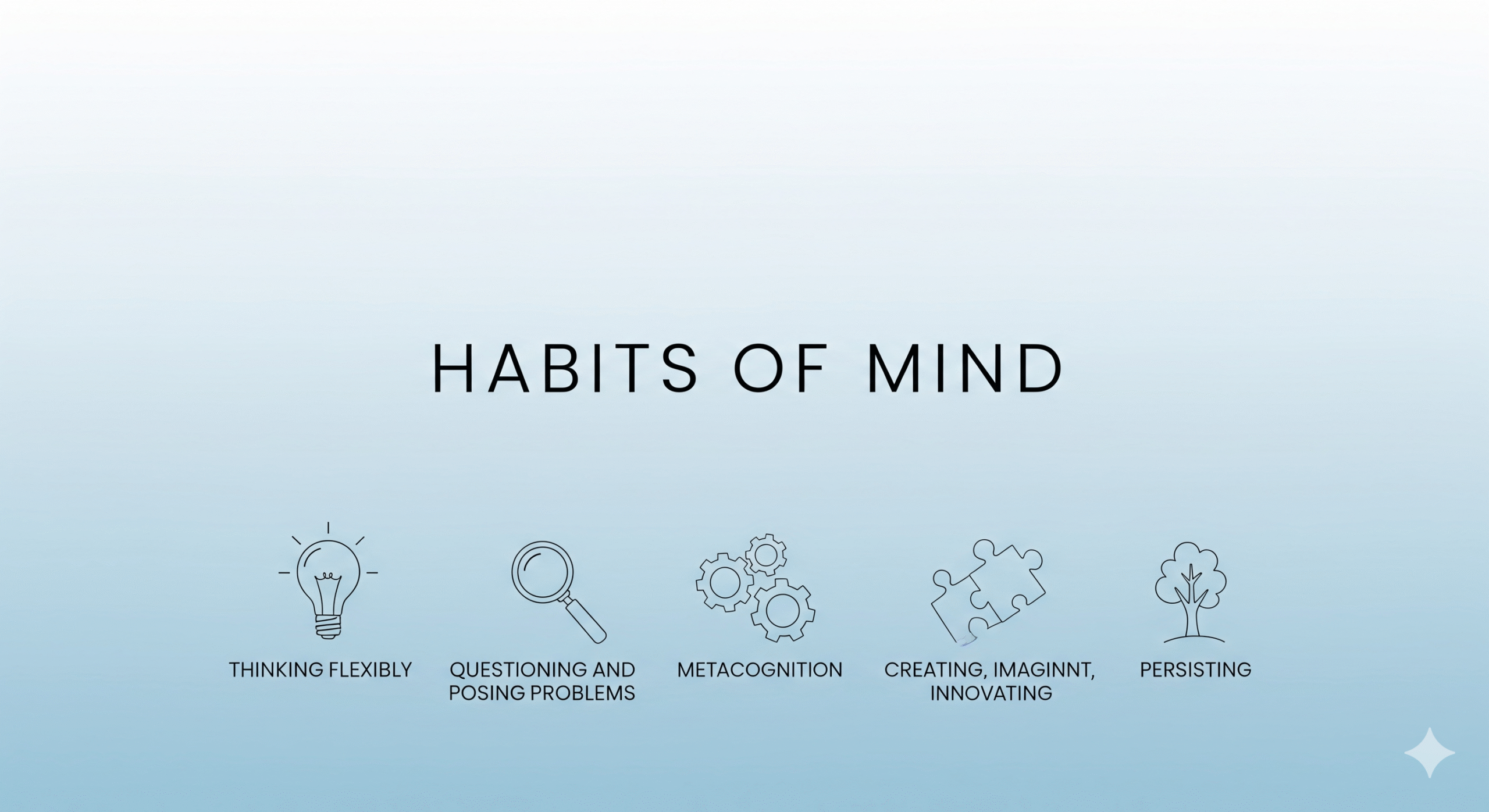
Habits of Mind
Human intelligence is not just about what we know but how we think. In education, psychology, and personal development, the concept of Habits of Mind has become a robust framework for cultivating more innovative, more adaptable, and resilient thinkers. Coined by educational experts Arthur L. Costa and Bena Kallick, Habits of Mind are patterns of intellectual behavior that lead to effective problem-solving and lifelong learning. Collaboration needs rehearsal as much as thinking does, and these team building activities for students are built around the debrief rather than the game.
This article delves into the 16 Habits of Mind in depth, connecting them to critical thinking, decision-making, problem-solving, creativity, resilience, and reflection, and explains how these habits can transform learning, work, and everyday life.
| Habit of Mind | Key Focus | Connection to Skills | Practical Example |
| Persisting | Perseverance | Builds resilience in overcoming obstacles | A student continues working on a challenging assignment until mastery |
| Managing Impulsivity | Self-control | Strengthens decision-making and patience | A professional pauses before responding to criticism |
| Thinking Flexibly | Adaptability | Supports problem-solving and creative thinking | An engineer rethinks a failed design from a new angle |
| Metacognition (Thinking About Thinking) | Self-awareness | Improves reflection and lifelong learning | A student analyzes which study methods work best |
| Questioning and Posing Problems | Curiosity | Sparks critical thinking and inquiry | A scientist asks “what if” questions to test new theories |
| Thinking and Communicating with Clarity and Precision | Effective expression | Improves decision-making and collaboration | Writing a concise project proposal |
| Gathering Data Through All Senses | Observation | Strengthens critical thinking and awareness | A chef tasting, smelling, and testing ingredients |
| Creating, Imagining, and Innovating | Originality | Encourages creativity and fresh solutions | Designing a new marketing campaign |
| Responding with Wonderment and Awe | Appreciation | Inspires lifelong learning and curiosity | Being amazed by a scientific discovery |
What Are Habits of Mind?
Habits of Mind refer to the behaviors and strategies that intelligent people use when they encounter challenges or uncertainties. Instead of relying on memorization or rigid rules, these habits encourage flexibility, persistence, creativity, and reflective thinking.
They are not just academic skills but universal life tools—relevant in classrooms, workplaces, and personal relationships. For example, when facing a challenging problem, someone guided by Habits of Mind won’t give up immediately. They will persist, ask questions, analyze from multiple angles, and learn from mistakes.

Origins and Importance of Habits of Mind
The framework was developed by Costa and Kallick in the 1980s, drawing inspiration from research in cognitive psychology, education, and creativity. Their central belief:
- Intelligence is not fixed; it can be developed and cultivated through deliberate habits and effective strategies.
- Success comes not only from knowing but from knowing how to approach complex or unfamiliar situations.
In today’s fast-paced world—where information changes rapidly—Habits of Mind are more critical than static facts. They encourage adaptability, emotional intelligence, and resilience in the face of uncertainty.
The 16 Habits of Mind
Below is a structured overview of all sixteen Habits of Mind, with explanations and real-life applications.
The 16 Habits of Mind and Their Applications
| Habit of Mind | Meaning | Application in Life/Work |
| 1. Persisting | Sticking with tasks even when they are difficult. | Finishing a challenging project despite setbacks. |
| 2. Managing Impulsivity | Thinking before acting; exercising self-control. | Pausing before sending an emotional email. |
| 3. Listening with Understanding and Empathy | Respecting and considering others’ perspectives. | Active listening in teamwork or relationships. |
| 4. Thinking Flexibly | Looking at problems from multiple angles. | Adapting when a business plan needs revision. |
| 5. Thinking About Thinking (Metacognition) | Being aware of your own thought process. | Reflecting on study strategies that work best. |
| 6. Striving for Accuracy | Checking work carefully and aiming for precision. | Reviewing a report for errors before submission. |
| 7. Questioning and Posing Problems | Curiosity and inquiry-driven thinking. | Asking why a process is failing instead of accepting it. |
| 8. Applying Past Knowledge to New Situations | Using what you’ve learned in different contexts. | Using leadership lessons from sports in the workplace. |
| 9. Thinking and Communicating with Clarity and Precision | Expressing ideas clearly and concisely. | Writing an email that avoids ambiguity. |
| 10. Gathering Data Through All Senses | Using observation, listening, and touch to learn. | Learning better by engaging in hands-on practice. |
| 11. Creating, Imagining, and Innovating | Generating new ideas and exploring possibilities. | Developing a new product design. |
| 12. Responding with Wonderment and Awe | Appreciating beauty, curiosity, and discovery. | Being inspired by nature or science. |
| 13. Taking Responsible Risks | Being willing to try new things despite uncertainty. | Launching a new business venture. |
| 14. Finding Humor | Seeing the lighter side of situations. | Using Humor to Defuse Workplace Tension. |
| 15. Thinking Interdependently | Collaborating and valuing group problem-solving. | Working effectively in a team project. |
| 16. Remaining Open to Continuous Learning | Being lifelong learners and staying curious. | Taking professional development courses. |

Habits of Mind and Critical Thinking
Critical thinking is the heart of intelligent behavior, and Habits of Mind serve as practical tools to develop it.
- Questioning and posing problems nurtures curiosity.
- Thinking flexibly helps avoid narrow judgments.
- Metacognition ensures self-awareness of biases and errors.
- Striving for accuracy reinforces logical and precise reasoning.
By integrating these habits, individuals strengthen their ability to analyze information, evaluate evidence, and make sound judgments.
Strategies for Resilience
Resilience—the ability to bounce back from setbacks—is central to lifelong success. Habits of Mind such as persisting, managing Impulsivity, and taking responsible risks directly support resilience. These habits cultivate a mindset in which challenges are viewed as opportunities rather than threats.
1. Persisting Through Academic Challenges
A student struggling with a difficult math concept demonstrates resilience by persisting in their efforts. Instead of giving up, they explore new problem-solving strategies, seek guidance, and practice until mastery is achieved.
2. Managing Impulsivity in Professional Settings
A professional facing criticism shows resilience by managing Impulsivity. Rather than reacting defensively, they reflect on the feedback, identify areas of improvement, and respond thoughtfully, turning criticism into a tool for growth.
3. Taking Responsible Risks in Entrepreneurship
An entrepreneur displays resilience by taking responsible risks. Even after a failed business attempt, they learn from mistakes, refine their strategies, and continue innovating instead of abandoning their goals.

Reflection and Metacognition
Reflection is more than looking back—it’s a deliberate process of analyzing one’s own thoughts, actions, and outcomes.
- Thinking about thinking (metacognition) helps learners assess what strategies work best.
- Applying past knowledge to new situations ensures lessons learned are never wasted.
- Reflection fosters growth by transforming experiences—both positive and negative—into stepping stones for improvement.
In education, reflective habits enable students to become self-directed learners, while in the workplace, they encourage employees to adapt and evolve.
Decision-Making and Problem-Solving
Strong decision-making and problem-solving skills require a blend of logic, creativity, and emotional intelligence, encompassing empathy and understanding. For example, thinking interdependently encourages collaboration when making group decisions, while gathering data through all senses ensures that choices are grounded in evidence rather than assumptions.
At the same time, creating, imagining, and innovating open the door to unconventional yet practical solutions, and managing Impulsivity allows individuals to make thoughtful choices instead of rushing into decisions. By integrating these habits of mind, individuals develop the ability to become effective leaders and adaptable problem solvers, capable of navigating complex and ever-changing environments.
Habits of Mind and Creativity
Creativity is often misunderstood as innate talent. In reality, it is a habit nurtured through practice and openness.
- Creating, imagining, and innovating directly foster creativity.
- Responding with wonderment and awe allows individuals to find inspiration in unexpected places.
- Finding Humor sparks fresh perspectives and novel connections.
When paired with critical thinking, these habits ensure creativity is not chaotic but purposeful and impactful.

Habits of Mind as Lifelong Learning Tools Habits of Mind as Lifelong Learning Tools
The 16 Habits of Mind are not limited to schools or workplaces—they serve as a blueprint for lifelong learning. They adapt to every stage of life, guiding individuals toward growth and adaptability.
Children
For children, Habits of Mind provide a foundation for curiosity and discovery. They encourage asking questions, experimenting, and developing the confidence to explore the unknown.
Students
Students apply the Habits of Mind to develop persistence, critical thinking, and reflection, which, in turn, lead to improved problem-solving skills and academic achievement.
Professionals
In professional environments, these habits foster creativity, adaptability, and leadership. They help individuals collaborate effectively, take responsible risks, and innovate in their fields.
Older Adults
For older adults, Habits of Mind offers tools for continuous learning and resilience, enabling them to adapt to new technologies, evolving social contexts, and foster lifelong personal growth.
Practical Ways to Cultivate Habits of Mind
- Daily Reflection Journals – Encourage awareness of thought patterns.
- Mindful Pause Practice – Build patience and manage Impulsivity.
- Group Discussions and Debates – Develop interdependence and empathy.
- Creative Challenges – Stimulate innovation and flexible thinking.
- Learning from Mistakes – Foster resilience and openness to growth.
These practices gradually transform thinking patterns into natural habits.

Conclusion
The framework of Habits of Mind offers more than just a set of strategies—it provides a philosophy of living. By practicing persistence, reflection, empathy, creativity, and openness to learning, individuals become more effective thinkers, resilient problem solvers, and lifelong learners.
In classrooms, these habits empower students. In workplaces, they inspire innovation. In personal lives, they bring balance, patience, and fulfillment.
As Costa and Kallick emphasized, the real test of intelligence is not what you know but how you behave when you don’t know. That is the essence of Habits of Mind—thinking smarter, living deeper, and learning forever.
Want to know about Quotes About Teaching: Timeless Words of Wisdom That Inspire Educators, Motivate Students, and Celebrate the Art of Learning Check out our education category.
FAQs
In an era of rapid change and information overload, effective habits of mind foster critical thinking, problem-solving, and lifelong learning, allowing individuals to navigate complexities successfully.
Critical thinking involves analyzing and evaluating information systematically and thoughtfully. To develop it, you can question assumptions, analyze arguments, and engage in reflective journaling.
Building resilience involves cultivating a positive mindset, enhancing emotional awareness, and developing strong support systems. Mindfulness practices and goal setting can also help.
Reflection enables individuals to think critically about their experiences, gaining insights that inform and enhance future behaviors and decision-making.