Choose a team building activity by the constraint you actually have — twelve minutes, no budget, 28 students, fixed desks — then protect five minutes at the end for a structured debrief. That order matters more than the activity. A mediocre game with a real debrief produces more durable collaboration than a brilliant game that ends at the bell.
Most articles hand you 25 games in no particular order and leave the selection problem — the hard part — to you. This one is organized around the two questions a teacher actually asks during the first week back: what fits my room and my clock, and what skill am I building? It also names the formats that quietly backfire, because a badly chosen icebreaker sets a class back further than doing nothing.
What the research actually supports
The strongest evidence for structured social skill work in schools comes from a meta-analysis by Joseph Durlak and colleagues covering 213 school-based, universal social and emotional learning programs and 270,034 students, K through 12. Published in Child Development (2011, vol. 82, no. 1, pp. 405–432), the Durlak meta-analysis found an 11-percentile-point gain in academic achievement, alongside significant improvements in conduct problems (mean effect size 0.22) and emotional distress (0.24).
Two details from that paper get dropped from most summaries. First, academic gains appeared only when school personnel ran the programs — not outside researchers or consultants. Second, the programs that worked shared four features the authors abbreviate as SAFE: sequenced activities that build on each other, active learning rather than lecture, at least one component focused on personal or social skills, and explicit targeting of a named skill rather than vague “positive development.” A one-off game on the first Friday fails three of those four tests.
For skill vocabulary, the CASEL framework is the standard reference. Its five competencies are self-awareness, self-management, social awareness, responsible decision-making, and relationship skills — and the fifth is what most team building claims to target, defined as establishing and maintaining supportive relationships, with “practicing teamwork and collaborative problem-solving” named explicitly. Stating which competency you are after turns a time-filler into instruction.
Why some group work produces learning and some produces resentment was mapped by David and Roger Johnson across a research base of more than 750 studies. Their five essential elements of cooperative learning are positive interdependence (no one succeeds unless everyone does), individual and group accountability, promotive interaction, explicitly taught social skills, and group processing. Cooperation compared with competition produced a mean effect size of 0.67 for achievement. An activity lacking positive interdependence and individual accountability is a game, not cooperative learning, and it will reliably let one confident student carry four passengers.

The activity selector
Read this table by constraint, not row order. Scan the columns you cannot change — time, space, budget — then pick from what survives. Grade bands are the sweet spot, not a ceiling; most stretch one band either way with adjusted debrief vocabulary.
| Activity | Grade band | Group size | Time | Space | Materials cost | Skill targeted |
|---|---|---|---|---|---|---|
| Name Toss (soft ball, name before throw) | K–2 | 10–24 | 8 min | Classroom circle | Free (one soft ball) | Names, turn-taking, attention |
| Story Chain (one sentence each) | K–2 | 6–12 | 10 min | Classroom | Free | Listening, building on others |
| Four Corners / This or That | K–2 to 9–12 | Whole class | 6 min | Classroom corners | Free | Low-risk self-disclosure |
| Silent Line-Up (by birthday, no talking) | 3–5 | Whole class | 8 min | Hallway or open floor | Free | Nonverbal communication |
| Cup Stack Challenge (rubber band and strings) | 3–5, 6–8 | 4–5 | 15 min | Classroom desks | Under $5 per class | Coordination, shared control |
| Paper Chain Challenge (longest chain, fixed supplies) | 3–5 | 4 | 20 min | Classroom tables | Scrap paper, tape | Planning under scarcity |
| Numbered Heads Together | 3–5, 6–8 | 4 | 10 min | Classroom | Free | Individual accountability |
| Jigsaw (each member teaches one segment) | 3–5 to 9–12 | 4–5 | 35 min | Classroom | Free (existing text) | Positive interdependence |
| Back-to-Back Drawing (describe, don’t show) | 6–8 | Pairs | 12 min | Classroom | Free (paper) | Precision in instruction |
| Spaghetti and Marshmallow Tower | 6–8 | 3–4 | 25 min | Classroom tables | About $1 per team | Prototyping, iteration |
| Chain Reaction (Rube Goldberg segment handoff) | 6–8, 9–12 | 3–4 teams | 45 min | Hallway or floor | Classroom scraps | Interface negotiation |
| Group Juggle (fixed toss pattern, add balls) | 6–8 | 10–15 | 12 min | Outdoor or gym | Free (3–5 balls) | Process improvement |
| Consensus Ranking (survival scenario) | 9–12 | 4–5 | 30 min | Classroom | Free printable | Disagreeing productively |
| Locked Box / Classroom Escape Puzzle | 9–12 | 4–6 | 45 min | Classroom | $0–15 (reusable) | Delegation, sequencing |
| Team Charter on a shared doc | 9–12 | 3–5 | 20 min | Virtual or classroom | Free | Norm-setting, role clarity |
| Collaborative Slide Deck (one slide per member) | 6–8, 9–12 | 4–6 | 25 min | Virtual | Free | Parallel work, integration |

Choosing in under two minutes
- Ten minutes and fixed desks: Numbered Heads Together, Back-to-Back Drawing, or Four Corners. All three work without moving furniture.
- A full period and a real skill goal: Jigsaw or Consensus Ranking — the only entries carrying academic content, so they earn their minutes twice.
- Zero budget: everything marked free. Paper Chain and Chain Reaction run on recycling-bin materials, and scarcity is part of the lesson.
- A hybrid or remote group: Team Charter and Collaborative Slide Deck. Both give every student a visible, attributable artifact — the only reliable substitute for a teacher walking the room.
- Day one, nobody knows anyone: Name Toss for K–2, Four Corners for everyone else. Save trust-dependent tasks for week two.
Formats that fail, and what to run instead
Some standard activities damage the students they are supposed to include. Six failure modes are worth recognizing before August turns into September.
1. The warm-up with no transfer
Students laugh, the timer goes off, class starts, nothing changes. This is the default outcome. The fix: name the target skill out loud before you start, then run the debrief below. If you cannot spare five minutes to debrief, run a shorter activity — never a longer one with no processing.
2. The loudest-voice format
Open brainstorms and “shout out an answer” games reward speed and volume, teaching quiet students that their contribution arrives too late to matter. The fix: insert 60 seconds of silent writing before any group talk, then require each member to read one line before open discussion. That single change redistributes airtime more than any seating chart.
3. The build where one student does everything
Tower challenges are the classic offender: one student with fast hands takes over and three watch. The fix: build in positive interdependence. Give each member a distinct material only they may handle, or assign roles — builder, materials manager, timekeeper, recorder — and rotate them mid-activity so no one settles into the comfortable job.
4. The disclosure trap
“Share a family vacation memory,” “describe your bedroom,” “bring an object from home,” “what did you get over break” — each converts family income, housing stability, and family structure into a performance in front of peers. Two Truths and a Lie belongs here too, because interesting truths usually cost money. The fix: anchor prompts in shared experience, not private resources. Ask about a skill they taught themselves, a food they would defend in an argument, or a rule they think is wrong. Every student has an answer, and none are means-tested.
5. The body-on-display game
Human Knot, trust falls, relay races, and anything involving being lifted, squeezed into a small space, or timed while running singles out students with disabilities, chronic pain, injuries, larger bodies, or ordinary adolescent self-consciousness. The fix: replace any activity requiring sustained physical contact or public physical performance. Silent Line-Up teaches the same nonverbal-communication lesson with no one touching anyone.
6. The competition that manufactures losers
Ranking teams first through sixth on day three tells five groups they are behind before instruction begins. The fix: compete against a standard or the class’s own previous time. Group Juggle works precisely because the class is beating its own record.

Making it work for every student
Accessibility is a design decision made before the activity, not an accommodation bolted on when a student freezes.
Students with disabilities
CAST’s Universal Design for Learning guidelines organize the work into three principles: multiple means of engagement, representation, and action and expression. In practice: give instructions verbally and on a visible card, let students contribute by writing, drawing, typing, or pointing rather than only speaking, and make sure every role can be performed while seated. Check the physical route too — an activity requiring students to cross a room crowded with backpacks is inaccessible before it begins.
Multilingual and English language learners
Small cooperative teams are genuinely good for language acquisition, generating peer interaction that develops language and content at once. Guidance from Colorín Colorado on cooperative learning strategies recommends teams of four that can split into pairs, mixing multilingual learners with fluent English-speaking peers as language models, and rotating team roles weekly so no student is permanently assigned the least verbal job. Structures with built-in turn-taking — Round Robin, Numbered Heads Together, Jigsaw — beat open discussion, because the turn arrives whether or not the student competes for it.
Anxious students
For a student with social anxiety, “we’re going to do an icebreaker” is a threat, not a treat. Three adjustments cost nothing: publish the activity in advance so nothing is a surprise, make whole-class speaking optional while speaking within a group of three is expected, and offer a defined non-speaking role that is obviously useful — timekeeper, recorder, materials manager. Sequence pair work, then group work, then whole-class work across the first two weeks. A settling routine helps too; a short poem read aloud lowers the temperature of a room more efficiently than asking everyone to calm down.
The debrief that makes it transfer
Group processing is one of the five essential elements of cooperative learning for a reason: it is where a shared experience becomes a rule the class can use next week. Budget five minutes. Run it in three moves.
What happened (2 minutes, factual)
- What did your group do first, and who decided that?
- At what moment did you get stuck? What was happening right before that?
- Name one thing someone in your group did that helped. Use the behavior, not the adjective.
So what (2 minutes, interpretive)
- Did everyone’s idea get heard? If not, what stopped it?
- Was the work split evenly? Be honest — no one is in trouble.
- What did disagreement sound like in your group, and did it help or stall you?
Now what (1 minute, forward-looking)
- What is one thing your group will do differently in the next group task?
- Where else in this class — or outside it — does this same problem show up?
Two ground rules make this work. Describe behaviors, never people: “we started building before we had a plan,” not “Marcus took over.” And have students write answers for 60 seconds before anyone speaks, so the debrief does not reproduce the airtime problem you are trying to fix. Post the “now what” commitments visibly and reference them by name the next time groups form — that repetition is what turns a one-off game into the durable thinking dispositions described in work on habits of mind.
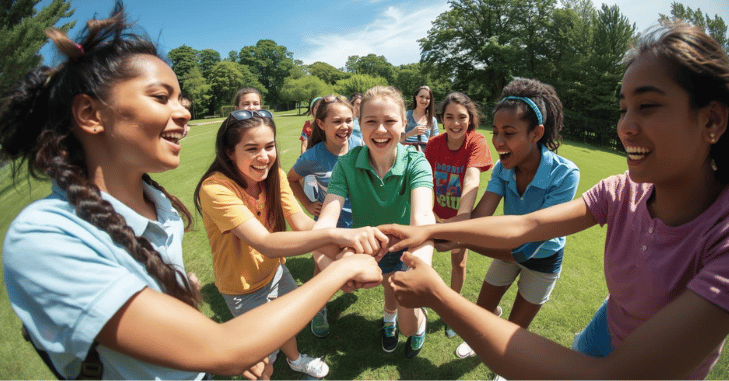
A two-week back-to-school sequence
Sequencing is one of the four SAFE features, so treat these as a progression, not a menu. Days one and two: names and low-risk preference sharing (Name Toss or Four Corners, five minutes each, no debrief needed yet). Days three through five: short paired tasks with a two-minute debrief — Back-to-Back Drawing, Numbered Heads Together. Week two: one longer cooperative task carrying real content, most usefully a Jigsaw over material you were teaching anyway, with the full debrief and a written team charter groups keep and revise.
The honest measure of success is not whether students enjoyed it. It is whether, six weeks later, a group that hits a disagreement resolves it without you. That skill outlasts the classroom — the same habits that make a functional project team are the ones that make an ordinary workday tolerable rather than exhausting. Teachers who take this seriously describe the work in terms closer to craft than curriculum, which is what the better quotes about teaching have always been getting at.
Pick two activities from the table this week. Name the skill. Run the debrief. That is the method.
What Teachers Ask Before Running These
Two structural features from Johnson and Johnson’s cooperative learning research: positive interdependence, meaning no student can succeed unless the group does, and individual accountability, meaning each member’s contribution is visible and assessed. Without both, one confident student does the work while the rest watch. Adding a five-minute structured debrief at the end is what turns the experience into a rule the class can reuse.
Five to ten minutes a day for the first week, then one longer cooperative task in week two that carries real academic content. The Durlak meta-analysis found that effective programs were sequenced rather than one-off, so short and repeated beats a single long session. Protect five minutes for the debrief every time, even if that means shortening the activity itself.
Avoid anything requiring sustained physical contact or public physical performance (Human Knot, trust falls, timed races), which singles out students with disabilities, injuries, larger bodies, or ordinary self-consciousness. Also avoid disclosure prompts tied to family resources, such as sharing a vacation memory, describing your bedroom, or bringing an object from home. Two Truths and a Lie belongs in this category too, since interesting truths usually cost money.
The Durlak et al. meta-analysis of 213 school-based universal SEL programs covering 270,034 students, published in Child Development in 2011, found an 11-percentile-point gain in academic achievement, plus significant improvements in conduct problems and emotional distress. Importantly, academic gains appeared only when school staff delivered the programs rather than outside consultants. That evidence applies to sequenced, skill-explicit programs, not to isolated icebreakers.
Publish the activity in advance so nothing is a surprise, make whole-class speaking optional while speaking within a group of three is expected, and offer a defined non-speaking role such as timekeeper, recorder, or materials manager. Sequence pair work first, then small groups, then whole-class formats across the first two weeks. Adding 60 seconds of silent writing before any group discussion also redistributes airtime away from the fastest talkers.
Run three moves in about five minutes. What happened: what did your group do first, where did you get stuck, and name one specific helpful behavior. So what: did everyone’s idea get heard, was work split evenly, and what did disagreement sound like. Now what: one thing the group will do differently next time, and where else that problem shows up. Have students write for 60 seconds before anyone speaks.
Research and Further Reading
- the Durlak meta-analysis — srcd.onlinelibrary.wiley.com
- the CASEL framework — casel.org
- five essential elements of cooperative learning — co-operation.org
- CAST’s Universal Design for Learning guidelines — udlguidelines.cast.org
- Colorín Colorado on cooperative learning strategies — colorincolorado.org