Most heavy cat shedding is normal coat turnover triggered by day length rather than temperature — but it stops being normal the moment you see bald patches, short stubbly hair, scabs, or a coat change paired with new thirst or weight loss. That one distinction — even thinning all over versus a defined spot you can point at — is what separates a vacuum-cleaner problem from a veterinary problem.
Cats do not have simple hair follicles. According to the Merck Veterinary Manual’s description of feline skin structure, their follicles are compound: one central guard hair surrounded by 3 to 15 smaller secondary hairs, all emerging from a single pore. Merck notes cats normally shed in early spring and early fall, and that the winter coat is built differently from the summer one — longer, finer hairs and more secondaries for insulation, versus shorter, thicker guard hairs for airflow.
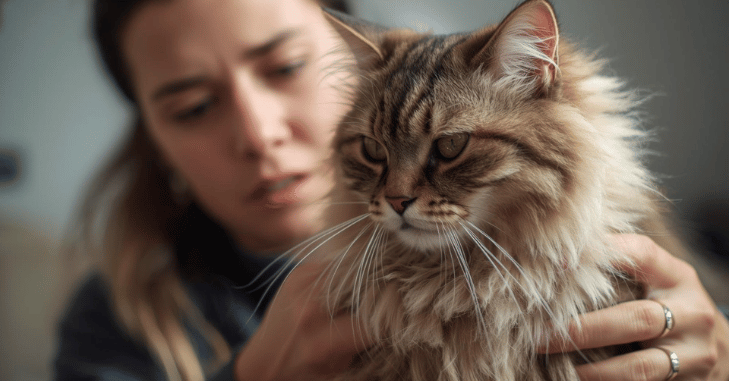
The 60-Second Triage Table: Normal Molt vs. Veterinary Red Flag
Run what you are seeing through this before you panic or before you shrug it off. The left column is a vacuum problem. The right column is a phone call.
| What you’re seeing | Usually normal shedding | Call the vet when | Likely culprit behind the red flag |
|---|---|---|---|
| Volume of hair | More hair on furniture and clothes, but the coat still covers the cat evenly | Shedding causes “obvious loss of the hair coat and bald spots” (Merck) | Parasites, allergy, infection, endocrine disease |
| Pattern | Diffuse and even; both sides equally furry | Symmetrical bare strips on the belly, inner thighs, or flanks | Feline acquired symmetric alopecia — Merck names flea allergy dermatitis as the top cause |
| Hair texture at the edge of thin areas | Whole hairs on the brush, tapered at the tip | Short, broken “stubble” that looks mowed rather than fallen out | Self-trauma from licking or biting, per Today’s Veterinary Practice |
| Skin underneath | Supple and clear, not greasy, flaky, or bumpy (VCA) | Redness, crusts, scabs, scaling, circular lesions, or color change | Ringworm, bacterial infection, mites, flea allergy dermatitis |
| Shape of bare areas | No bare areas at all | Circular patches of loss with broken, stubbly hair and crusty skin | Ringworm (dermatophytes) — zoonotic, meaning it spreads to people |
| Grooming behavior | Cats normally spend 30–50% of the day grooming (Cornell) | Licking that breaks the skin surface, or a sudden jump in hairball frequency | Allergy or parasite itch first; behavioral causes are rarer than assumed |
| Rest of the cat | Normal appetite, weight, thirst, and energy | Coat looks “unkempt, matted, or greasy” plus weight loss, big appetite, or increased thirst | Hyperthyroidism or diabetes mellitus — both middle-aged-to-senior diseases |
| Itch level | Occasional scratching | Scratching or over-grooming on the neck, tail head, lower back, or thighs | Fleas — cats are bitten most on the neck and tail head (Cornell) |
One clarifier that saves a lot of worry: Merck states plainly that if there are no bald patches, heavy shedding most likely represents normal coat renewal. Volume alone is not a diagnosis.
It’s Daylight, Not Heat — Which Is Why Indoor Cats Shed in February
The most common owner misconception is that cats shed because it’s hot. They don’t. Photoperiod — daylight hours hitting the retina — is the primary signal pushing follicles out of anagen (growth) into telogen (rest), after which hair releases. The American Animal Hospital Association’s explainer on pet shedding lays out that three-stage cycle — anagen, catagen, telogen — and notes indoor pets “may shed more consistently year-round due to artificial lighting and stable temperatures.”
Geography matters too. Dr. William H. Miller, VMD, medical director at the Cornell University Companion Animal Hospital, has pointed out that the influences on shedding differ in the Northeast versus Florida — a cat in Buffalo gets a far sharper seasonal light swing than a cat in Miami.
This explains the January search at 11 p.m.: your indoor cat lives under a light schedule you control. Lamps on until midnight, blackout curtains, a thermostat that never moves — the follicles never get a clean seasonal signal, so instead of two dramatic molts the cat drips hair constantly. VCA Animal Hospitals notes that cats in cooler climates with outdoor access tend to have two heavy sheds a year, in late spring and late fall, while indoor cats generally shed at low levels year-round.
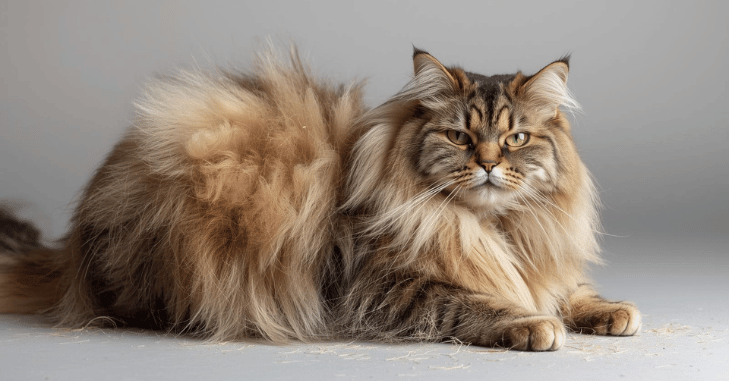
Coat type sets the ceiling on how much hair there is to lose. A domestic long-haired cat carries far more secondary hair than a shorthair, and heavy-coated breeds — the Maine Coon, also the biggest cat breed in the world by most measures — shed a volume of undercoat that looks alarming even when nothing is wrong.
The Five Red Flags Worth a Same-Week Appointment
1. Bald patches or symmetrical hair loss
Merck distinguishes self-induced hair loss (the cat removes it by over-grooming or scratching) from spontaneous loss (the follicle itself fails). Bilateral, mirror-image thinning has a clinical name — feline acquired symmetric alopecia — and Merck identifies flea allergy dermatitis as its most common cause. Hormonal disorders tend to produce non-inflammatory alopecia that doesn’t itch at first, which is why owners often fail to connect it to illness.
2. Over-grooming — and why “it’s just stress” is usually wrong
Dr. Pamela Perry of the Cornell University College of Veterinary Medicine notes cats spend roughly 30 to 50 percent of their day grooming, so heavy licking is baseline. Dr. William Miller, Jr., Professor Emeritus of Medicine at Cornell, frames the threshold: licking becomes a problem when it causes excessive hair loss or breaks the skin’s surface. Cornell’s write-up on cats that lick too much lists bald patches, skin abrasions, and an abnormal jump in hairball production as the signs to watch.
Here is the part most articles get backwards. A 2006 study by Waisglass and colleagues in the Journal of the American Veterinary Medical Association worked up 21 adult cats presumptively diagnosed with “psychogenic alopecia.” Sixteen turned out to have a medical cause of itch; only two had a purely behavioral disorder, and three had both. Adverse food reactions accounted for a large share. The authors concluded psychogenic alopecia is overdiagnosed in cats and that thorough testing should precede any behavioral label. If you’re told your cat is bald because it’s anxious, that conclusion belongs last, not first.
3. Fleas, mites, and the bites you can’t see
The relevant species is Ctenocephalides felis felis, and the Cornell Feline Health Center’s guide to fleas supplies the number that ends any “but I don’t see fleas” argument: one mated female lays at least 20 eggs a day, and in about two months that population can reach roughly 20,000 adults. Cats with flea allergy dermatitis develop reddish, crusty bumps, and bites cluster on the back of the neck and top of the tail head — exactly the spots a cat cannot groom well, and exactly where you should part the fur to look.
4. Circular lesions and stubbly hair: ringworm
Ringworm is not a worm. It is a dermatophyte fungus that survives by digesting keratin, the structural protein in hair and nails — which is why infected hairs snap off. Cornell’s ringworm resource describes circular areas of hair loss, broken stubbly hair, scaling or crusty skin, and inflamed patches. Under a Wood’s lamp, fungus-coated hairs glow yellowish-green. Two facts matter: ringworm is zoonotic and passes from cat to human, and curing it takes at least six weeks or so of repeated treatment. This is not a wait-and-see situation.
5. Coat change plus thirst, appetite, or weight change
This combination is worth memorizing, because the coat is often the first sign of systemic disease an owner notices. The Cornell Feline Health Center’s page on feline hyperthyroidism lists a coat that appears unkempt, matted, or greasy alongside weight loss, increased appetite, increased thirst and urination, vomiting, diarrhea, and hyperactivity. It mainly affects middle-aged and older cats, most of whom show high T4 on bloodwork. Radioactive iodine therapy resolves roughly 95 percent of cases, usually normalizing hormone levels within one to two weeks.
Diabetes mellitus produces an overlapping picture. Merck’s material on feline pancreatic disorders lists increased thirst and urination alongside increased appetite and weight loss as the most common signs, with middle-aged to older cats most affected and obesity a major risk factor. A cat that suddenly looks scruffy and is emptying the water bowl needs bloodwork, not a better brush.
The Uncomfortable Truth About “Hypoallergenic” Cats
Owners searching about shedding are often really searching about allergies — theirs, or a partner’s. Here is the point almost nobody puts plainly: the hair is not the allergen, and low-shedding breeds do not solve allergies.
The dominant cat allergen is a protein called Fel d 1. A 2024 comparative genomics paper in PNAS Nexus analyzing Fel d 1 across 276 cats — 140 domestic and 136 exotic cats spanning 37 wild species — describes Fel d 1 as a secretoglobin produced in the sebaceous, salivary, perianal, and lachrymal glands. Roughly 95 percent of cat-allergic patients mount an IgE response to it, and Fel d 1 accounts for something like 60 to 90 percent of the total anti-cat immune response. Expression varies enormously between individual cats and even within the same cat over time.
The hair is simply the delivery vehicle. A cat grooms, coats its fur in saliva, the saliva dries, and the protein goes airborne on flakes of skin and hair fragments — the same basic mechanism by which any inhaled protein sensitizes an airway, which is how occupational conditions such as baker’s lung develop from repeated exposure to flour proteins.
The American Academy of Allergy, Asthma & Immunology is blunt about the marketing: “Contrary to popular opinion, there are no truly ‘hypoallergenic breeds’ of dogs or cats. Allergic dander in cats and dogs is not affected by length of hair or fur, nor by the amount of shedding.” Hairless Sphynx cats secrete Fel d 1 too.
In fairness to the nuance: a small 2014 study in Clinical and Translational Allergy comparing 6 conventional cats against 8 marketed as hypoallergenic did find reduced Fel d 1 on the face and chest of the latter group. But 14 cats is a thin basis for a purchasing decision, and reduced is not zero. The variables that track more reliably with allergen output aren’t breed at all — unneutered males produce substantially more Fel d 1 than females or neutered males, and older cats tend to produce less than younger ones.
Practical translation: if allergies are the real driver, neutering status, individual cat variation, and aggressive cleaning matter far more than the breed on the paperwork. Choose on temperament instead — the friendliest cat breeds are a more useful filter than a “hypoallergenic” label with no scientific standing.
What Actually Reduces the Hair in Your House
Assuming your cat cleared the triage table, the interventions that work are unglamorous.
- Brush to the skin, not across the top. AAHA’s guidance is explicit that brushing must reach the skin to lift loose undercoat — daily for heavy shedders, two to three times weekly otherwise. Surface brushing moves hair around without removing it.
- Time it to the phase. During anagen, hair resists removal; during telogen it epilates easily. Brushing during a molt removes far more per stroke.
- Don’t over-bathe. Frequent bathing strips natural oils, and most healthy adult cats rarely need it.
- Feed for the coat. VCA lists dull coat, dry scaling, hair color changes, and slow regrowth among visible signs of nutritional shortfall, and highlights marine omega-3s (EPA and DHA) for modulating inflammation and itch.
- Keep flea prevention year-round. Indoor-only status is not protection, and prevention that stops in October leaves a gap a heated house happily fills.
- Treat hairballs as a data point. A sudden increase means the cat is ingesting more hair — from a real shedding increase or from over-grooming.
Two Situations That Look Alarming and Usually Aren’t
First, the exam-table explosion. Many cats shed dramatically at the clinic and the carrier comes home lined with fur. Acute stress releases already-loose telogen hairs all at once. It looks shocking, it is temporary, and it is not a disease.
Second, the seasonal-molt overshoot. A cat dropping its winter coat in a warm spring can look like it’s coming apart while the skin stays perfect and coverage stays continuous. Merck’s threshold applies: no bald spots, no lesions, normal appetite and thirst — most likely normal renewal.
The line to hold onto: shedding is about quantity, and quantity is rarely the problem. Hair loss is about coverage, skin condition, and the rest of the cat — that is where the diagnosis lives. This article is general information, not a substitute for veterinary advice; any bald patch, skin lesion, sudden coat change, or change in thirst, appetite, or weight should be evaluated by a licensed veterinarian.
Common Questions From Cat Owners
Why is my indoor cat shedding so much in winter?
Shedding is driven mainly by photoperiod (day length), not temperature. The American Animal Hospital Association notes that indoor pets may shed more consistently year-round because artificial lighting and stable indoor temperatures blunt the seasonal light signal. Instead of two concentrated molts in spring and fall, an indoor cat under lamps until midnight sheds at a low, constant rate all twelve months.
How do I tell normal shedding from actual hair loss?
Look at coverage, not volume. The Merck Veterinary Manual’s threshold is that shedding becomes abnormal when it results in obvious loss of the hair coat and bald spots; without bald patches, heavy shedding most likely reflects normal coat renewal. Also check the hair at the edge of any thin area: whole tapered hairs suggest normal shedding, while short broken stubble suggests the cat is licking or chewing it off.
Can stress alone cause a cat to lose hair?
Rarely, and it should never be the first conclusion. A 2006 study by Waisglass and colleagues in the Journal of the American Veterinary Medical Association worked up 21 cats presumptively diagnosed with psychogenic alopecia: 16 had an underlying medical cause of itch, only 2 were purely behavioral, and 3 had both. Adverse food reactions were a leading finding. The authors concluded psychogenic alopecia is overdiagnosed and that full diagnostic testing should precede any behavioral label.
Do hypoallergenic or low-shedding cat breeds help with allergies?
Not meaningfully. The American Academy of Allergy, Asthma & Immunology states there are no truly hypoallergenic breeds of dogs or cats, and that allergic dander is not affected by hair length or the amount of shedding. The main allergen, Fel d 1, is a protein secreted by the sebaceous, salivary, perianal, and lachrymal glands, and roughly 95 percent of cat-allergic people react to it. Hairless Sphynx cats still produce it.
What diseases cause excessive shedding or a poor coat in cats?
Hyperthyroidism is a leading one in middle-aged and older cats; the Cornell Feline Health Center lists an unkempt, matted, or greasy coat alongside weight loss, increased appetite, and increased thirst and urination. Diabetes mellitus overlaps, with increased thirst, urination, appetite, and weight loss. Fleas, ringworm, mites, and food or environmental allergies are the other common drivers. Coat change plus a change in thirst, appetite, or weight warrants bloodwork.
How often should I brush a heavily shedding cat?
AAHA recommends daily brushing for heavy shedders and two to three times weekly otherwise, and stresses brushing all the way to the skin to lift the loose undercoat rather than skimming the surface. Timing helps too: hair in the telogen (resting) phase epilates easily with a brush or comb, while anagen-phase hair resists removal, so brushing during an active molt removes far more per stroke.
Veterinary References
- Merck Veterinary Manual’s description of feline skin structure — merckvetmanual.com
- American Animal Hospital Association’s explainer on pet shedding — aaha.org
- VCA Animal Hospitals notes — vcahospitals.com
- cats that lick too much — vet.cornell.edu
- guide to fleas — vet.cornell.edu
- ringworm resource — vet.cornell.edu
- Cornell Feline Health Center’s page on feline hyperthyroidism — vet.cornell.edu
- PNAS Nexus analyzing Fel d 1 across 276 cats — academic.oup.com
- American Academy of Allergy, Asthma & Immunology — aaaai.org